
HELPFUL GUIDE
Sole trader or limited company? A simple guide for small business owners
Choosing whether to operate as a sole trader or a limited company is one of the biggest decisions you'll make when starting or growing a business.
It affects your tax, take-home pay, paperwork, risk and even how your business is perceived by clients.
The good news is that there is no perfect choice for everyone. Once you understand the differences, the right option usually becomes much clearer.
If you are unsure which structure is right for your business, feel free to get in touch.
What's the difference?
Sole trader
As a sole trader:
You are the business
You keep all profits after tax
You are personally responsible for any debts or liabilities
For many people, it is the simplest and most straightforward way to start a business.
Limited company
A limited company is a separate legal entity from you personally.
As the owner, you will usually act as both:
Director
Shareholder
The company earns the income and then pays you through salary, dividends or a combination of both.
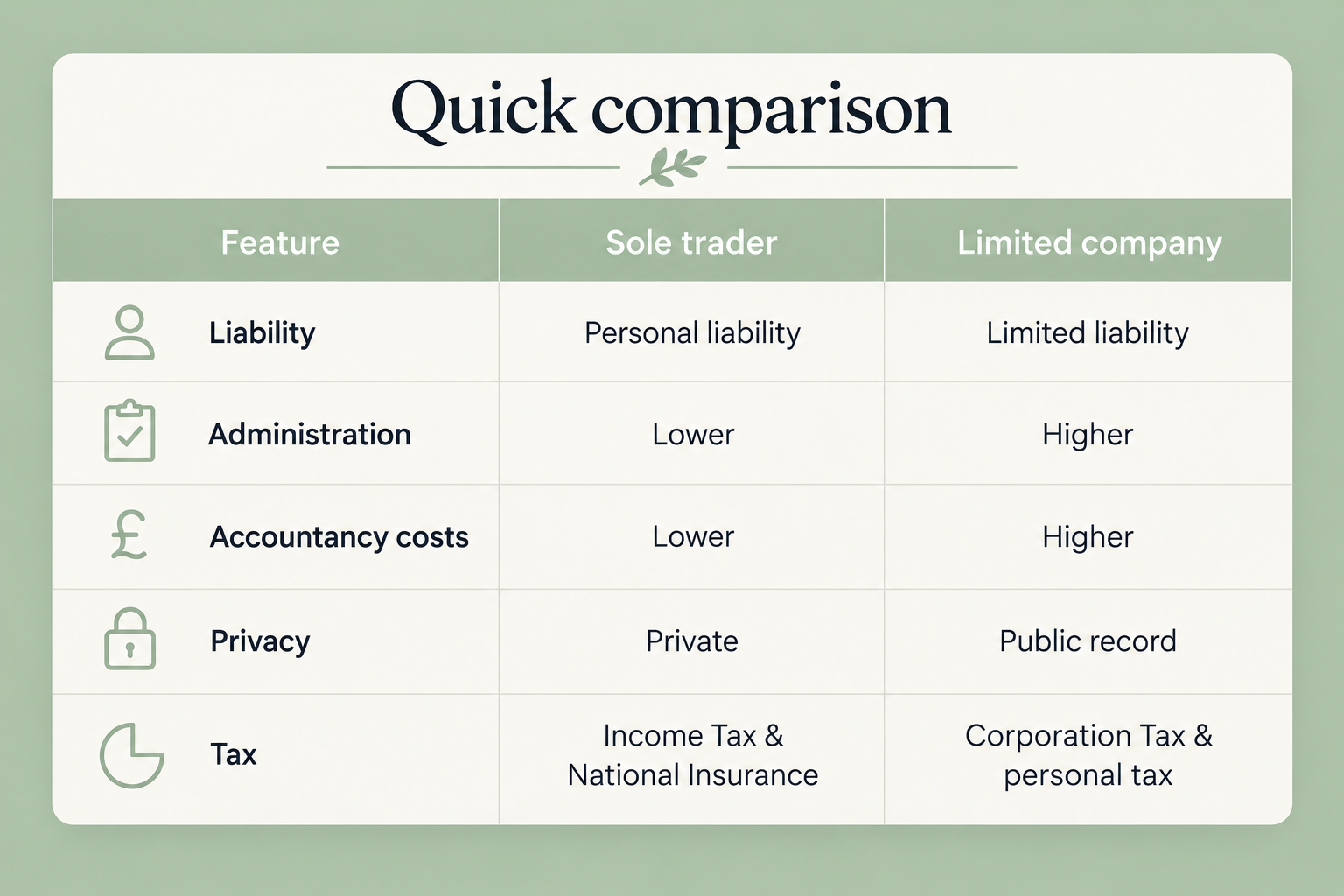
Sole trader: pros & cons
Advantages
✔ Simple to set up and run
✔ Minimal paperwork
✔ Lower accountancy costs
✔ Full control over business decisions
✔ Greater privacy
✔ Easy access to profits
Things to consider
✘ You are personally liable for business debts
✘ Higher profits can sometimes result in higher tax bills
✘ Some industries prefer working with limited companies
✘ Personal and business finances can become blurred
Limited company: pros & cons
Advantages
✔ Limited liability protection
✔ Can be more tax efficient at higher profit levels
✔ Often viewed as more professional
✔ Easier to bring in business partners or investors
✔ Clear separation between business and personal finances
Things to consider
✘ More paperwork and compliance responsibilities
✘ Higher accountancy costs
✘ Company information is publicly available through Companies House
✘ Company money belongs to the company rather than you personally
Frequently asked questions
Which option pays less tax?
It depends.
Factors include:
Profit levels
Salary and dividend mix
Whether profits are reinvested
Personal circumstances
Limited companies can often become more tax efficient once profits increase, but every situation is different.
I'm worried about the admin
This is one of the most common concerns.
Limited companies do involve more paperwork, but much of this can be handled by your accountant.
What about liability?
If your business involves contracts, equipment, employees or financial risk, limited liability can provide valuable protection.
Will a limited company look more professional?
In some industries, yes.
Construction, consulting, IT and creative sectors often expect businesses to operate as limited companies.
Can I change later?
Absolutely.
Many business owners start as sole traders and move to a limited company when the timing makes sense.
Which is cheaper to run?
Generally speaking:
Sole Trader
Lower accountancy costs
Fewer filing requirements
Limited Company
Higher compliance requirements
Higher accountancy costs
Which protects my personal assets?
A limited company.
This is one of the main reasons many business owners decide to incorporate.
Can I pay myself however I want?
Sole Trader
All profits belong to you after tax.
Limited Company
Income is usually taken through salary, dividends or a combination of both.
Can I get a mortgage as a limited company director?
Yes.
However, lenders may require additional documentation when assessing affordability.
Need help applying this to your business?
Every business is different.
If you're unsure how Making Tax Digital, tax returns or business structure decisions apply to your situation, I'd be happy to help.